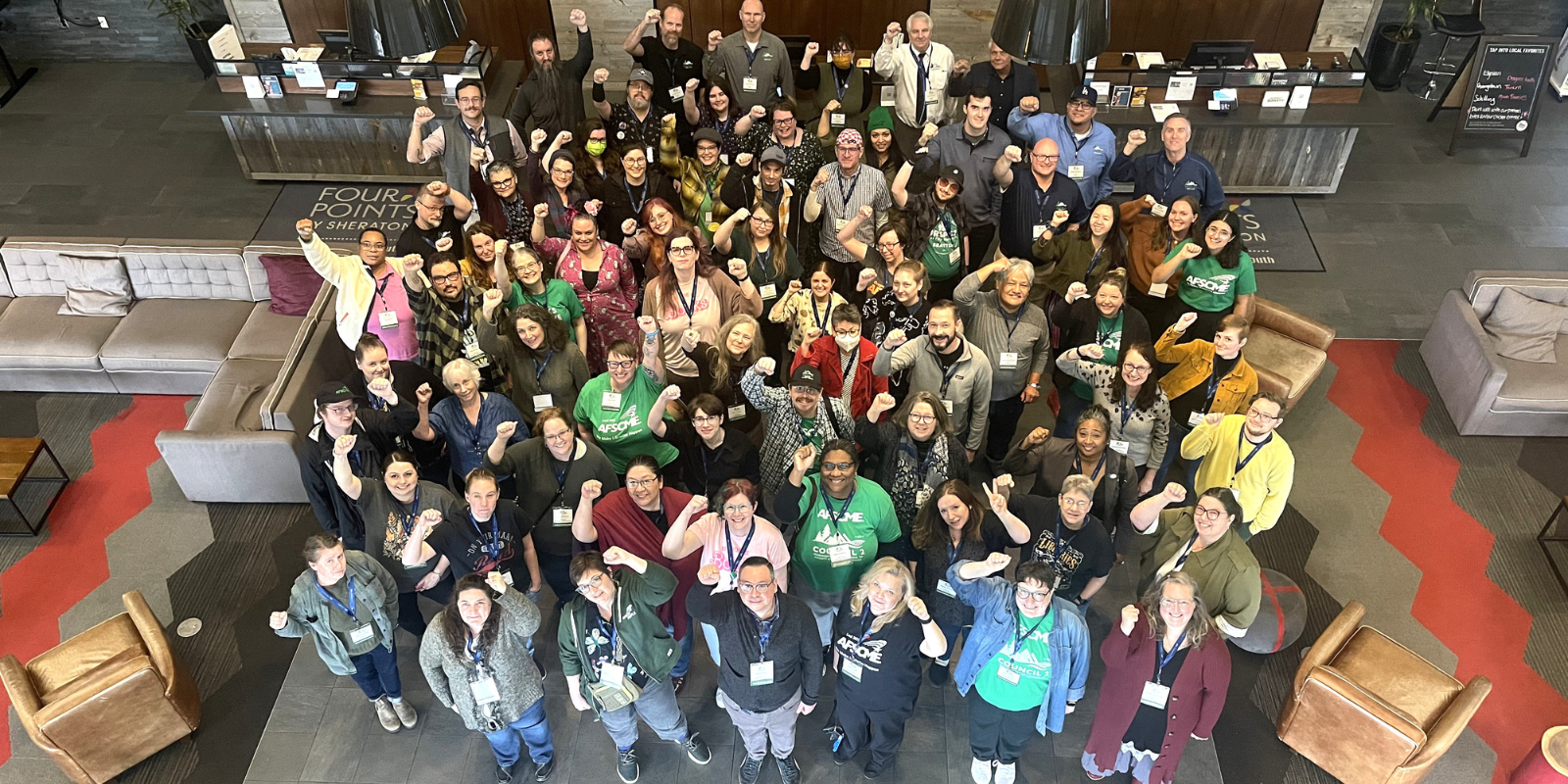
SEATTLE – Nearly 100 AFSCME members from 17 library systems all over the Pacific Northwest gathered on Nov. 15 for the first AFSCME Council 2 Library Summit — a day focused on taking collective action around health and safety issues library workers face.
AFSCME President Lee Saunders told attendees in a video message that the summit provided a “unique opportunity for AFSCME library workers throughout the Pacific Northwest to learn from each other and build stronger bonds of solidarity.”
He praised Council 2 for energetically organizing in this sector. Council 2 now represents workers at nearly every local public library system in Washington state. Saunders also highlighted the robust organizing being done by Oregon AFSCME (Council 75) and the Washington Federation of State Employees (AFSCME Council 28).
Saunders noted that library workers everywhere face increasing demands, and are grappling with budget and public service cuts.
“It all makes for extremely difficult working conditions, with your economic security and even your physical safety threatened,” Saunders said. “The way we fight back is by educating, organizing and mobilizing every single day. That’s what this gathering is all about.”
The hub of community service
Libraries play a major role in serving their communities. They not only provide access to literary resources, but social support such as language learning services, legal advice, job search assistance, internet access and programming for kids as well. They are the heart of our communities and provide a welcoming, safe space for everyone.
That’s the root of what inspired Kim Larson — who works at the Sno-Isle Regional Library and is vice president of AFSCME Local 73 (Council 2) — to pursue a 25-year career in libraries. Larson is also a member of the Council 2 Library Caucus, a group of members across Washington state who played an instrumental role in shaping the direction of the summit.
“I work in libraries because it is a delight to spend my days making sure important services are accessible to everyone in my community,” said Larson.
At the same time, library workers are on the front lines of various societal challenges and are often expected to serve roles they never expected to take on — such as social work, health care or security — sometimes with little to no training. Due to the nature of their work, they’re also at risk of workplace harassment and violence, as well as physical, biological, ergonomic and chemical hazards.
A key goal of the summit was to create space for members to share how these hazards affect them and their co-workers.
“To hear others relating all the same experiences shattered any sense of isolation,” Larson said. “We now know that we can have a unified voice, support one another and take action together to make change.”
Opportunities to learn
Workshops covered a wide range of topics. Those included workers’ rights under the federal Occupational Safety and Health Act and state laws, tools to identify and understand occupational hazards, and finding potential solutions through bargaining, organizing and legislative advocacy.
These workshops highlighted a spectrum of tools to use in addressing health and safety hazards and discuss ways to work together. Members left the summit feeling empowered and energized to take action with their AFSCME siblings. They also realized that every step they take to improve their workplace strengthens our union and builds collective power. Health and safety are not privileges but rights.
“I feel so much more informed about ways to advocate for health and safety for our members, both as issues arise and in crafting our next CBA,” said Larson. “I feel that those who attended from my local will be bringing back and sharing a sense of belonging to a larger family, all with common goals and interests, leading to fresh energy, boldness and courage as we continue to build and strengthen our young local.”
AFSCME Cultural Workers United is leading the largest organizing movement for library employees and workers in other cultural institutions across the country. We represent 50,000 workers at museums, zoos, libraries and other such institutions — more than any other union.